

Pillion
Um romance homossexual dissidente

Com roteiro premiado na Mostra Um Certo Olhar, Pillion desmonta pré-julgamentos e padrões de relacionamento ao narrar o romance (sem aspas) entre o submisso Colin (Harry Melling) e o calado Ray (Alexander Skarsgård), o membro de um grupo gay de motoqueiros, que em certo momento são simbolizados por duas raças de cachorro: o primeiro, o dachshund; o segundo, o rottweiler. Não preciso dizer mais nada, certo?
Entretanto, a estreia de Harry Lighton na direção de longas-metragens é bem mais do que a óbvia simbologia acima: a obra inscreve a homossexualidade sem discriminação no tecido da família e sociedade. Os pais de Colin são abertos quanto à sexualidade do filho, mesmo que a mãe, com câncer em estágio terminal, ainda conserve uma tradição conservadora: Colin deve convidar Ray para os pais conhecerem com quem o seu filho está se envolvendo. Os motoqueiros são todos gays, adeptos à cultura do couro, e até mesmo parecem ter saído das filmagens de Magic Mike diretamente para a adaptação do livro de Adam Mars Jones. O interesse de Lighton não é com a homossexualidade, garantida e protegida, mas com o “contrato” de submissão que entrelaça Colin e Ray. Como é possível amar alguém que te trata como empregado doméstico, obriga você a dormir no chão, ou determina a sua maneira de vestir ou pentear-se? É onde habita a tensão da narrativa.
Engraçado que, repassando as minhas anotações, em duas ocasiões, eu anotei “tóxico”, e, em outra, “romance entre aspas”, e com o desenvolvimento da narrativa percebi que a minha ignorância, que alimenta o meu preconceito, estava enviesando o meu olhar, o qual era frequentemente desafiado pela receptividade de Colin à submissão. É a forma padrão de amar, desejar ou de se relacionar, em oposições a formas não convencionais, desviantes ou dissidentes, que ferve nas entranhas de Pillion - o termo empregado para quem anda na garupa da motocicleta. Não é a corrente com cadeado, que deve curvar a coluna de um, nem a proibição de tocar no piano de Ray que mais incomodam Colin, é a inveja de não poder beijá-lo na boca, ou a incapacidade de tirá-lo do sério. Repito: é possível amar alguém nesses termos? E a resposta só pode ser sim… consensualmente, claro.
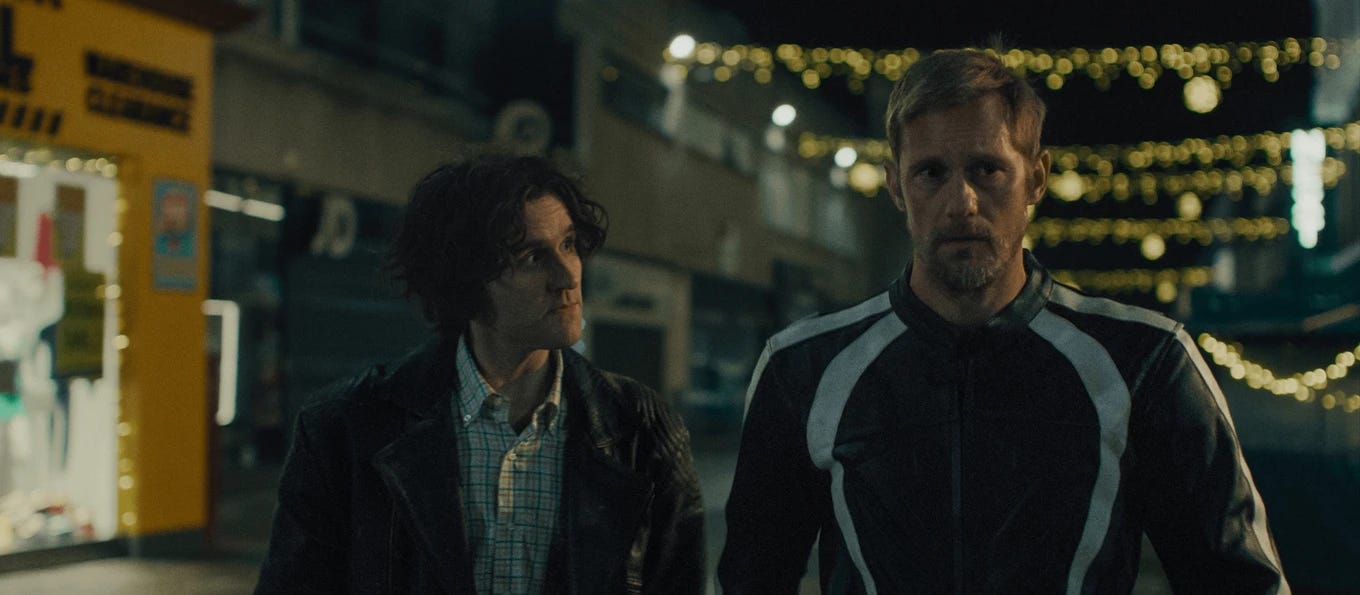
Lighton não busca indícios ou traumas do passado para justificar os comportamentos dos seus personagens, ou compreendê-los dentro do viés da psicanálise. Assim como a homossexualidade não é problematizada, nem fonte de conflito e ansiedade, tampouco a relação desviante. De certo modo, Lighton elabora um romance de amadurecimento, no qual Colin aprende o limite que pode suportar, enquanto desafia Ray a transformar-se para satisfazer o parceiro. Às vezes, algum elemento escapa por entre os dedos e os personagens parecem menos completos do que poderiam ser; em outros momentos, a direção emprega imagens elementares, tais como as sombras de barras refletida sobre o corpo dos personagens em ocasiões diversas, mas com o mesmo significado. Mesmo assim, isso não atrapalha a capacidade disruptiva de Pillion.
Sim, estamos em 2025, e 50 Tons de Cinza já apresentou ao público - da pior forma que poderia fazer, é verdade - uma versão palatável para reacionário ver sobre BDSM, mas Lighton planta interrogações emocionais no espectador, enquanto ‘normaliza’ - nunca gosto desta palavra neste contexto - o relacionamento apresentado entre um agente de fiscalização de estacionamento e um motoqueiro. Um que multa a menor transgressão e um habitualmente relacionado à transgressão, ainda que apenas dentro de uma visão estereotipada e que não necessariamente adira à realidade. Melling e Skarsgård criam uma química estranhamente atraente, um casal que jamais imaginaria ser possível, se não os estivesse vendo com os meus olhos. Skarsgård interpreta com sua envergadura um homem de voz serena e de atitude à primeira vista indiferente, que revela, entre as ranhuras de sua personalidade, a construção de afeto dentro da possibilidade presente.
Já Melling atua como quem esperasse obter o menor sorriso de aprovação de Ray - não ironicamente, eu também comecei a ansiar por isso com o tempo, o que me parece um acerto da narrativa. Melling é doce, sem ser pegajoso; é submissão, despersonalizando-se no processo, mas sem abdicar de uma fagulha de autoamor dentro dele. É o coração de um filme envolvente e maduro no tema apresentado e na forma com que isto é feito e um prêmio merecido para Lighton.
English review
With an award-winning script at the Un Certain Regard, Pillion dismantles preconceptions and relationship patterns by narrating the romance (without quotation marks) between the submissive Colin (Harry Melling) and the quiet Ray (Alexander Skarsgård), a member of a gay biker group, who at a certain point are symbolized by two breeds of dog: the first, the dachshund; the second, the rottweiler. I don't need to say anything else, right?
However, Harry Lighton's debut as a feature film director is much more than the obvious symbolism above: the work inscribes homosexuality without discriminating it in the fabric of family and society. Colin's parents are open about their son's sexuality, even though his mother, who has terminal cancer, still maintains a conservative tradition: Colin must invite Ray so that his parents can meet who their son is getting involved with. The bikers are all gay, into leather culture, and even seem to have stepped straight from the filming of Magic Mike into the adaptation of Adam Mars Jones' book. Lighton's interest is not in homosexuality, taken for granted, but in the "contract" of submission that intertwines Colin and Ray. How is it possible to love someone who treats you like a domestic servant, forces you to sleep on the floor, or dictates the way you dress or do your hair? This is where the tension of the narrative lies.
It's funny that, when I was reviewing my notes, on two occasions I wrote "toxic" and, on another, "romance in quotation marks", and as the narrative developed I realized that my ignorance, which feeds my prejudice, was biasing my view, which was frequently challenged by Colin's receptiveness to submission. It is the standard way of loving, desiring or relating, as opposed to unconventional, deviant or dissident forms, that boils in the entrails of Pillion - the term used for someone who rides on the back of a motorcycle. It is not the chain with a padlock, which must bend one's spine, nor the prohibition of playing Ray's piano that bothers Colin the most, it is the envy of not being able to kiss him on the mouth, or the inability to get him angry. I repeat: is it possible to love someone in these terms? And the answer can only be yes... consensually, of course.
Lighton does not seek clues or traumas from the past to justify the behavior of his characters, or to understand them from the perspective of psychoanalysis. Just as homosexuality is not problematized, nor is it a source of conflict and anxiety, neither is the deviant relationship. In a way, Lighton creates a coming-of-age novel, in which Colin learns the limits he can bear, while challenging Ray to transform himself to please his partner. Sometimes, some element slips through the fingers and the characters seem less complete than they could be; at other times, the direction uses elementary images, such as the shadows of bars reflected on the characters' bodies on different occasions, but with the same meaning. Even so, this does not hinder Pillion's disruptive capacity.
Yes, it is 2025, and 50 Shades of Grey has already presented the public - in the worst way it could, it is true - with a palatable version of BDSM for reactionaries to see, but Lighton plants emotional questions in the viewer, while 'normalizing' - I never like this word in this context - the relationship presented between a parking enforcement officer and a biker. One who fines the slightest transgression and one who is habitually related to transgression, even if only within a stereotypical vision that does not necessarily adhere to reality. Melling and Skarsgård create a strangely attractive chemistry, a couple that I would never have imagined possible, if I were not seeing them with my own eyes. Skarsgård plays with his stature a man with a calm voice and an attitude that at first glance seems indifferent, who reveals, between the cracks of his personality, the construction of affection within the present possibility.
Melling acts as someone who hopes to get the slightest smile of approval from Ray - not ironically, I also began to yearn for this over time, which seems to me to be a success of the narrative. Melling is sweet, without being clingy; he is submissive, depersonalizing himself in the process, but without giving up a spark of self-love within him. It is the heart of an engaging and mature film in the theme presented and in the way it is done, and a deserved award for Lighton.